Schottenbauer Publishing

Showing posts with label science. Show all posts

Monday, April 18, 2016

Breathing Patterns

Breathing is an essential component of all forms of physical exercise. 

How can breathing be measured? Take a moment to write a list of variables relevant to breathing. 

Respiration rate (number of breaths per unit time), lung capacity, depth of respiration, and rate of airflow are all ways to measure breathing. 

A spirometer measures the rate of flow of air from breathing. Consider the graphs of spirometer readings below, excerpted from a book series by Schottenbauer Publishing.


Discussion Questions
  1. In each graph above, what are the maximum and minimum flow rates?
  2. In each graph above, what is the period of breath cycle? 
  3. In each graph above, what is the frequency of breath cycle? 
  4. Why is the first graph not a perfect sine wave?
  5. Why is the second graph not showing the same shape as the first graph?


Additional Information

Friday, March 11, 2016

Science of Yoga & Ballet Memorabilia

Celebrate the sport science of ballet and yoga with memorabilia from Zazzle! Colorful graphs from Schottenbauer Publishing are featured on these mugs, magnets, keychains, & postcards. Direct links to each collection are included below:


Ballet & Dance          Yoga

A variety of other sport science collections are also available from Schottenbauer Publishing on Zazzle, which features regular sales on most items.  


Additional Information

Schottenbauer Publishing 

Free Education Resources

Friday, December 25, 2015

The Geometry of Ballet & Yoga

Geometry is essential for physical activities such as ballet and yoga. Take a moment to write down a few ways in which geometry affects the precision of these activities. 

Discussion Questions
  1. What data is necessary to collect in order to understand the role of geometry in ballet and/or yoga? 
  2. What spatial perspectives and/or mathematical planes are important for precision? 

The cover of The Geometry of Balletto the right above, features a dancer in action. 

Discussion Questions
  1. What angles can be measured on the diagram, in order to understand the accuracy of technique?  
  2. Is any essential information missing from the picture? What is necessary in order to measure that information?
The cover of The Geometry of Yogato the right below, features a yoga pose. 

Discussion Questions
  1. What angles can be measured on the diagram, in order to understand the accuracy of technique?  
  2. Is any essential information missing from the picture? What is necessary in order to measure that information?

Geometry diagrams featuring ballet and yoga are available in the following books from Schottenbauer Publishing:

Geometry Workbooks

Wednesday, October 7, 2015

The Mathematics of Goniometer Readings

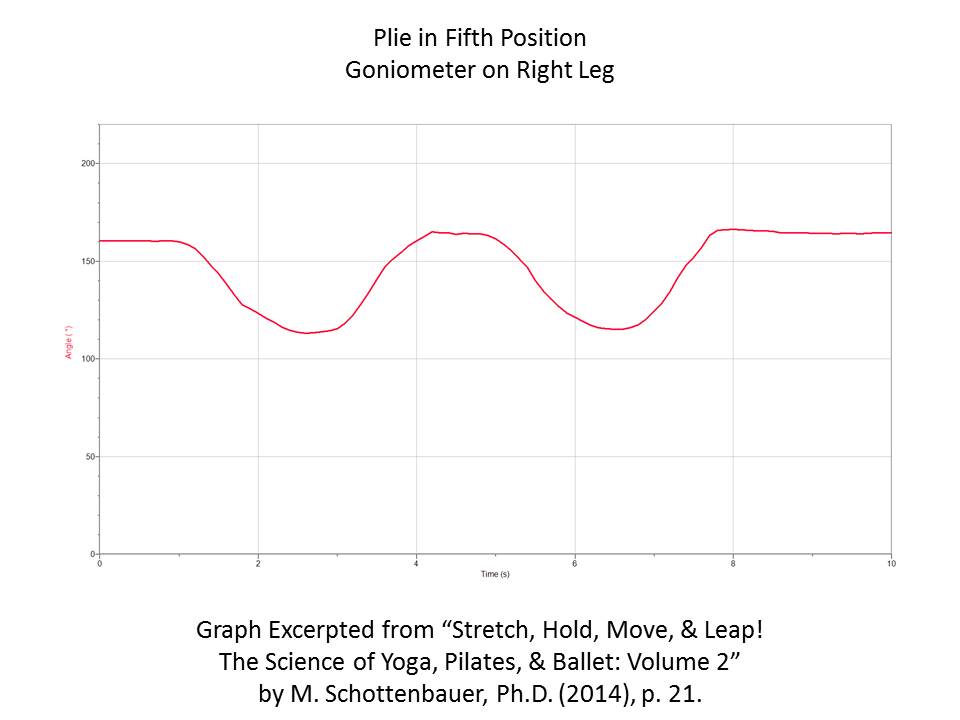
A goniometer is a device which measures joint angles, such as those made repetitively in ballet, dance, PIlates, and yoga. Goniometer readings often appear as sine waves, and can be analyzed as such.

Consider the following graph, excerpted from The Science of Yoga, Pilates, & Ballet: Volume 2 from Schottenbauer Publishing:


Discussion Questions
  1. What is the initial position of the knee? Is the leg entirely straight?
  2. What is the deepest angle of bending at the knee?
  3. What is the range of angles contained in the graph?
  4. Counting from the bottom of the first trough, what is the amplitude of the oscillation? 
  5. Counting from the bottom of the first trough, what is the wavelength of the oscillation? 
  6. What is the frequency of the oscillation?
  7. How many knee bends are included in the graph?

Additional graphs of goniometer readings are available in the same volume, The Science of Yoga, Pilates, & Ballet: Volume 2 from Schottenbauer Publishing. Similar physics data is also available in Volume 2 of several other lab manual series, including The Science of Athletic TrainingThe Science of Exercise EquipmentThe Science of Gymnastics, and more.


Additional Information

Schottenbauer Publishing

Friday, August 21, 2015

How Is Acceleration Relevant to Yoga?

As one of the slowest sports, yoga may not seem to contain much acceleration. The phenomena of acceleration, however, is essential to understanding the benefits of yoga, due to the effects of gravity. Gravity is the force which pulls all matter towards the center of the earth. On the earth's surface, the pull of gravity is associated with acceleration downwards. Yoga includes poses in various positions, including full and partial inversions. Therefore, various yoga poses engage the acceleration of earth's gravity in different ways.

Consider the following graph of a sun salutation sequence, excerpted from The Science of Yoga, Pilates, & Ballet: Volume 1 from Schottenbauer Publishing:


Discussion Questions
  1. Which direction is initially in the vertical position: x, y, or z? Why? (Hint: What is the acceleration due to gravity at the earth's surface?)
  2. Separate the graph into four sections, based on position. Label each section with one of the following: (a) Bow at Waist with Hands in Front or Behind Legs, (b) Hands Up and Around to Backbend, (c) Hands Up and Around to Standing Prayer Position, (d) Standing Prayer Position.
  3. What are the effects of gravity on fluids in the body (blood, lymph, etc.) during these motions?
  4. How might these differences in acceleration affect the health benefits and/or risks of yoga?


Additional Information

Schottenbauer Publishing

Saturday, March 7, 2015

Science of Yoga, Pilates, & Ballet: Volume 4

A new volume of The Science of Yoga, Pilates, & Ballet: Data & Graphs for Science Lab has arrived! Volume 4 features brightly colored graphs depicting a variety of complex moves. Examples include a yoga sun salutation, Pilates splits, backbend, and inverted bicycle, and a series of ballet leaps (Glissade, Sauté, Soubresaut, Pas Assemblé, Pas de Chat, Sissonne Fermée, Royale, Grand Jeté, and Cabriole). The book also contains graphs showing ballet jumps with a variety of axes options, as well as comparison data from the motion of a ball flying through the air, falling, and bouncing on a carpet.

The two sample graphs below are excerpted from Volume 4:


Discussion Questions
  1. What is the minimum and the maximum for each variable in these graphs?
  2. Which leg rises into the air first?
  3. How high is the jump?
  4. How long is the person in the air?
  5. Does either ankle ever rise higher than either knee?
  6. Is this correct technique for glissade?
  7. Draw a sketch of the person's movement at five (5) points during the move, to show what the move looks like to an audience. Use a stick figure.
  8. Where should the arms be for the glissade? Draw the ideal position of the arms on each of your sketches from #7. Then, draw a graph showing the ideal movement of the arms. Use a separate graph for the right and left arms. Include Shoulder, elbow, and wrist in your graphs.

Additional Information

Schottenbauer Publishing

Thursday, December 11, 2014

The Science of Yoga, Pilates, & Ballet: Suggested Activities


The science book series Stretch, Hold, Move, & Leap! The Science of Yoga, Pilates, & Ballet Volumes 1, 2, & 3 by M. Schottenbauer, Ph.D., contain a treasure-chest of graphs filled with physics and biophysics variables. The following are a small sample of the many questions which can be explored in this series of books!

Activity Questions for Volume 1: Force & Acceleration!
  • What does a flat step on a force plate look like? (Find the answer on page 27!) What about stepping on toe? (Answer on page 30!) What is the difference between these two motions?
  • During Pilates arm circles, does anything happen to the feet? (Find the answer on page 22!)
  • Describe the forces and reactions involved in toe lifts, first from the perspective of the mover, then from the perspective of a force plate underneath the feet. (Find the answer in the graph above!)

Activity Questions for Volume 2: Biophysics!
  • What are the effects of spinal twists on blood pressure and pulse? (Find the answer on page 88!) 
  • In order to lower blood pressure immediately, is it better to do a partial inversion with legs raised, or 15 minutes of aerobic exercise? (Answer on pages 88-90!)
  • Compare the flow rate and volume of normal breathing with slow and fast yoga breathing (pranayama), respectively. (Answers on pages 80-83!)

Activity Questions for Volume 3: Plots of Motion!
  • Do Pilates arm circles look different in an x-y plot when graphed from the front view, when compared to arm circles graphed from the side view? (Answer on page 10-11!)

  • The Science of Yoga, Pilates, & Ballet
    • Volume 1: Force & Acceleration
    • Volume 2: Biophysics
    • Volume 3: Video Analysis

Anthologies of 28 Graphs
    • The Science of Yoga
    • The Science of Dance & Ballet

    Related books, appropriate for younger students, include the following:

    Geometry Workbooks
    • The Geometry of Yoga
    • The Geometry of Ballet 

    Additional information on these and related book series is available on the author's blog on Sport Science Education.


    Additional Information

    Schottenbauer Publishing

    Tuesday, September 23, 2014

    Scientific Analysis of a Ballet Plie Jump

    The plie jump is one of ballet's best moves for demonstrating basic physics. Essentially, the jump consists of a straight up-and-down motion. The jump begins from a legs-bent position, and ends in a similar stance, usually with foot position reversed. 

    The slides below show a plie jump and the resulting graph of motion. A video of the move and analysis is available on YouTube.


    Discussion Questions
    1. Where is the origin of the x-y axis in these pictures?
    2. Redraw the graph with the origin at (a) the center of the feet, (b) the lower left corner of the page, (c) the initial position of the head, and (d) one other point on the picture.
    3. What is the height of the jump?
    4. How high is the jump, compared to the height of the person? What is the proportion of the height of the jump to the height of the person?
    5. What forces are relevant for understanding the motion of the jump?
    6. What occurs at the beginning and end of the jump?
    7. What equation describes the free motion of the vertical component of the jump (e.g., the component of the jump when the person is not touching the ground)? 
    8. What practical advice would improve the height of the jump?

    Graphs such as the ones above can be found in the following book series:


    • The Science of Yoga, Pilates, & Ballet
      • Volume 1: Force & Acceleration
      • Volume 2: Biophysics
      • Volume 3: Video Analysis

    Anthologies of 28 Graphs
      • The Science of Yoga
      • The Science of Dance & Ballet

      Related books, appropriate for younger students, include the following:

      Geometry Workbooks
      • The Geometry of Yoga
      • The Geometry of Ballet 

      Additional information on these and related book series is available on the author's blog on Sport Science Education.


      Additional Information

      Schottenbauer Publishing

      Friday, September 19, 2014

      New Book Series Provide Direct Access to Science of Yoga, Pilates, Dance, & Ballet

      The science of exercise has now become even more accessible to the public, with new educational books by M. Schottenbauer, Ph.D. Written for students from grades 7 through high school, college, and university, these lab manuals feature graphs of the physics and biophysics of yoga, Pilates, dance, ballet, and other popular sports. The data can be used to supplement traditional curricula in a variety of classes, including math, science, health, and physical education.

      The following two graphs, excerpted from one of the books, compare electrical signals in the left bicep during two yoga positions.


      Discussion Questions:

      1) How much variation in electrical activity is present in Graph 1? In Graph 2?
      2) Which graph shows a greater increase in electrical activity during the pose?
      3) Which pose requires greater effort to produce?
      4) What is the activation pattern of the forearm muscles during each pose?
      5) Which yoga pose is more relaxing during the pose? 
      6) Which yoga pose is more relaxing after the pose?
      7) Does this scientific data suggest which yoga pose should come first, in a good routine?


      Graphs such as the ones above can be found in the following book series:


      • The Science of Yoga, Pilates, & Ballet
        • Volume 1: Force & Acceleration
        • Volume 2: Biophysics
        • Volume 3: Video Analysis

      Anthologies of 28 Graphs
        • The Science of Yoga
        • The Science of Dance & Ballet

        Related books, appropriate for younger students, include the following:

        Geometry Workbooks
        • The Geometry of Yoga
        • The Geometry of Ballet 

        Additional information on these and related book series is available on the author's blog on Sport Science Education.


        Additional Information

        Tuesday, August 5, 2014

        The Science of Yoga, Pilates, Dance, & Ballet


        The science and math of yoga, pilates, dance, and ballet are topics of new books from Schottenbauer Publishing. Presenting data from real exercises collected by the science writer and publisher M. Schottenbauer, Ph.D., these books bring the "high tech" end of stretching, holding, moving, and leaping to audiences everywhere!

        In these books, students can enjoy learning about common moves from yoga, pilates, dance, and balletOne series of books, written for elementary school students, focuses on geometry. Two series of science books feature graphs and data, illustrating common mathematical functions, plus a variety of concepts from physics and biophysics. The science books can be integrated into classes such as math, physical science, physics, physical education, and health, anywhere from 7th grade through high school, as well as some introductory college and university classes. 

        Books include the following:

        • The Geometry of Yoga
        • The Geometry of Ballet 
        Graphs & Data for Science Lab: Multi-Volume Series
        • The Science of Yoga, Pilates, & Ballet
          • Volume 1: Force & Acceleration
          • Volume 2: Biophysics
          • Volume 3: Video Analysis
        Anthologies of 28 Graphs
          • The Science of Yoga
          • The Science of Dance & Ballet

          These books are complemented by a series of science books on other popular sports topics, including Olympic sports, athletic training, exercise equipment, gymnastics, and more. Relevant topics include:

          Geometry Workbooks
          • The Geometry of Gymnastics
          Graphs & Data for Science Lab: Multi-Volume Series
            • The Science of Athletic Training 
              • Volume 1: Force & Acceleration
              • Volume 2: Biophysics
              • Volume 3: Video Analysis
            • The Science of Exercise Equipment 
              • Volume 1: Force & Acceleration
              • Volume 2: Biophysics
              • Volume 3: Video Analysis
            • The Science of Gymnastics 
              • Volume 1: Force & Acceleration
              • Volume 2: Biophysics
              • Volume 3: Video Analysis
            Anthologies of 28 Graphs
              • The Science of Physical Fitness
              • The Science of Gymnastics

              Most of the books above are available in both English and German translation. The books pertaining to the geometry of Olympic sports are also available in 15 world languages. 

              The same publisher offers similar books on additional popular topics, including sports, transportation, construction, environment, music, entertainment, and general physics. All of these book series are available in several formats and languages, including the following:

              Geometry Workbooks

              • Print & E-Book Editions
              • Available in English & German
              • Olympics Books Available in 15 Languages
              • Ballet Book Available in 3 Languages (English, German, & Chinese)
              Graphs & Data for Science Lab: Multi-Volume Series
              • Print Editions
              • Available in English & German
              Anthologies of 28 Graphs
              • Print Editions
              • English Only


              Unbeatable Specials

              With Kindle Unlimited ($9.99/month) at Amazon.com, you can read all e-books from Schottenbauer Publishing for no extra charge! Amazon offers Free 30 Day Trials of Kindle Unlimited. With this deal, trial members can read all Schottenbauer Publishing e-books free! This includes all the geometry workbooks, plus "The World in a Graph," "Alphabets of the World," textbooks on the science of music, all the e-book puzzles, and the educational novels by M. Schottenbauer, Ph.D.