Breathing is an essential component of all forms of physical exercise.
How can breathing be measured? Take a moment to write a list of variables relevant to breathing.
Respiration rate (number of breaths per unit time), lung capacity, depth of respiration, and rate of airflow are all ways to measure breathing.
A spirometer measures the rate of flow of air from breathing. Consider the graphs of spirometer readings below, excerpted from a book series by Schottenbauer Publishing.
Discussion Questions
- In each graph above, what are the maximum and minimum flow rates?
- In each graph above, what is the period of breath cycle?
- In each graph above, what is the frequency of breath cycle?
- Why is the first graph not a perfect sine wave?
- Why is the second graph not showing the same shape as the first graph?
Additional Information
 Geometry is essential for physical activities such as ballet and yoga. Take a moment to write down a few ways in which geometry affects the precision of these activities.
Discussion Questions
- What data is necessary to collect in order to understand the role of geometry in ballet and/or yoga?
- What spatial perspectives and/or mathematical planes are important for precision?
The cover of The Geometry of Ballet, to the right above, features a dancer in action.
Discussion Questions
- What angles can be measured on the diagram, in order to understand the accuracy of technique?
- Is any essential information missing from the picture? What is necessary in order to measure that information?
The cover of The Geometry of Yoga, to the right below, features a yoga pose.
Discussion Questions
- What angles can be measured on the diagram, in order to understand the accuracy of technique?
- Is any essential information missing from the picture? What is necessary in order to measure that information?
 Geometry diagrams featuring ballet and yoga are available in the following books from Schottenbauer Publishing:
Geometry Workbooks
- The Geometry of Ballet
- The Geometry of Yoga
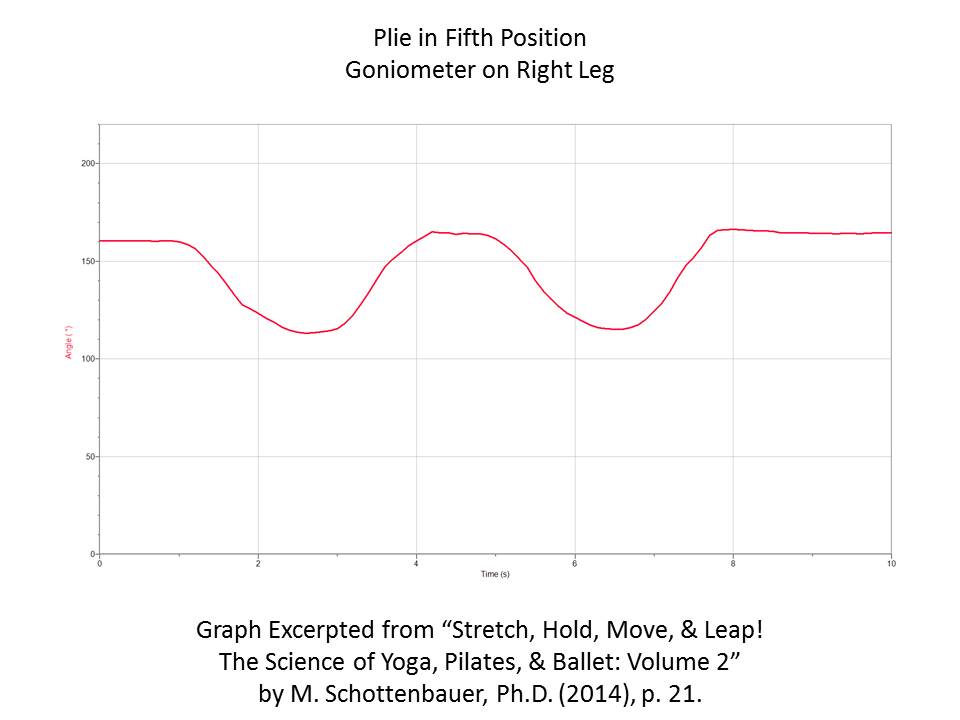
A goniometer is a device which measures joint angles, such as those made repetitively in ballet, dance, PIlates, and yoga. Goniometer readings often appear as sine waves, and can be analyzed as such.
Consider the following graph, excerpted from The Science of Yoga, Pilates, & Ballet: Volume 2 from Schottenbauer Publishing:
Discussion Questions
- What is the initial position of the knee? Is the leg entirely straight?
- What is the deepest angle of bending at the knee?
- What is the range of angles contained in the graph?
- Counting from the bottom of the first trough, what is the amplitude of the oscillation?
- Counting from the bottom of the first trough, what is the wavelength of the oscillation?
- What is the frequency of the oscillation?
- How many knee bends are included in the graph?
Additional graphs of goniometer readings are available in the same volume, The Science of Yoga, Pilates, & Ballet: Volume 2 from Schottenbauer Publishing. Similar physics data is also available in Volume 2 of several other lab manual series, including The Science of Athletic Training, The Science of Exercise Equipment, The Science of Gymnastics, and more.
Additional Information
Schottenbauer Publishing
As one of the slowest sports, yoga may not seem to contain much acceleration. The phenomena of acceleration, however, is essential to understanding the benefits of yoga, due to the effects of gravity. Gravity is the force which pulls all matter towards the center of the earth. On the earth's surface, the pull of gravity is associated with acceleration downwards. Yoga includes poses in various positions, including full and partial inversions. Therefore, various yoga poses engage the acceleration of earth's gravity in different ways.
Consider the following graph of a sun salutation sequence, excerpted from The Science of Yoga, Pilates, & Ballet: Volume 1 from Schottenbauer Publishing:
Discussion Questions
- Which direction is initially in the vertical position: x, y, or z? Why? (Hint: What is the acceleration due to gravity at the earth's surface?)
- Separate the graph into four sections, based on position. Label each section with one of the following: (a) Bow at Waist with Hands in Front or Behind Legs, (b) Hands Up and Around to Backbend, (c) Hands Up and Around to Standing Prayer Position, (d) Standing Prayer Position.
- What are the effects of gravity on fluids in the body (blood, lymph, etc.) during these motions?
- How might these differences in acceleration affect the health benefits and/or risks of yoga?
Additional Information
Schottenbauer Publishing